
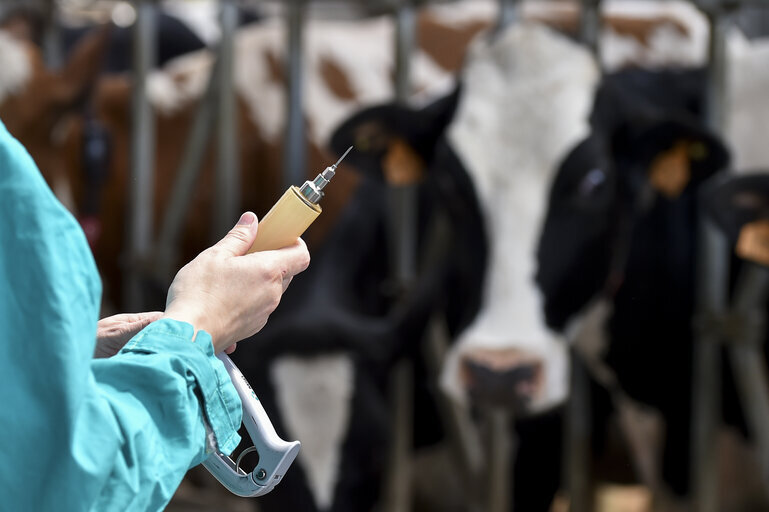
A new peer-reviewed paper published in Viruses provides fresh evidence that preventive vaccination should play a much greater role in controlling transboundary animal diseases in Europe. The paper, co-authored by former FVE intern Carolina Baptista, Wiebke Jansen and Nancy De Briyne (FVE), together with experts including Bart de Leeuw (EVERI) and Jobke Van Hout, reinforces the recommendations of the recent FVE position paper, Animal Vaccination: A Socio-Economic Cornerstone of Animal Health and European Resilience.
Vaccination-to-live versus stamping out
Drawing on scientific literature, outbreak reports and EU policy documents, the authors compared the impact of protective vaccination with traditional stamping-out strategies for major viral diseases such as lumpy skin disease (LSD), highly pathogenic avian influenza (HPAI) and foot-and-mouth disease (FMD). The authors also cite the recent reclassification of bluetongue virus (BTV), acknowledging that eradication is no longer realistic and that vaccination provides the most sustainable and cost-effective means of limiting disease impact.
Reducing the size and duration of outbreaks
The review concludes that vaccination can substantially reduce the size and duration of outbreaks while limiting economic losses in certain epidemiological situations. For LSD, vaccination-to-live is considered essential, as culling alone has proved insufficient for eradication. For HPAI, the changing epidemiological situation supports a greater use of vaccination-to-live strategies. Although vaccination also offers clear epidemiological benefits for FMD, its wider adoption remains constrained by international trade considerations linked to maintaining disease-free status.
A stronger framework for Europe
The authors argue that Europe should move towards risk-based preventive vaccination programmes, supported by harmonised legislation, wider use of DIVA strategies (allowing differentiating infected from vaccinated animals), and trade rules that facilitate emergency vaccination without unnecessary market disruption. France's experience with duck vaccination against HPAI demonstrates that vaccination-to-live can be successfully implemented while maintaining trade.
Preventive vaccination: essential to improving Europe’s resilience
With notifiable transboundary diseases posing an increasing threat to animal health, welfare and food security, the paper concludes that strengthening vaccination, preparedness and regulatory frameworks through a One Health approach is essential to improving Europe's resilience.
(photo ©Eric Vidal/EU2018)