
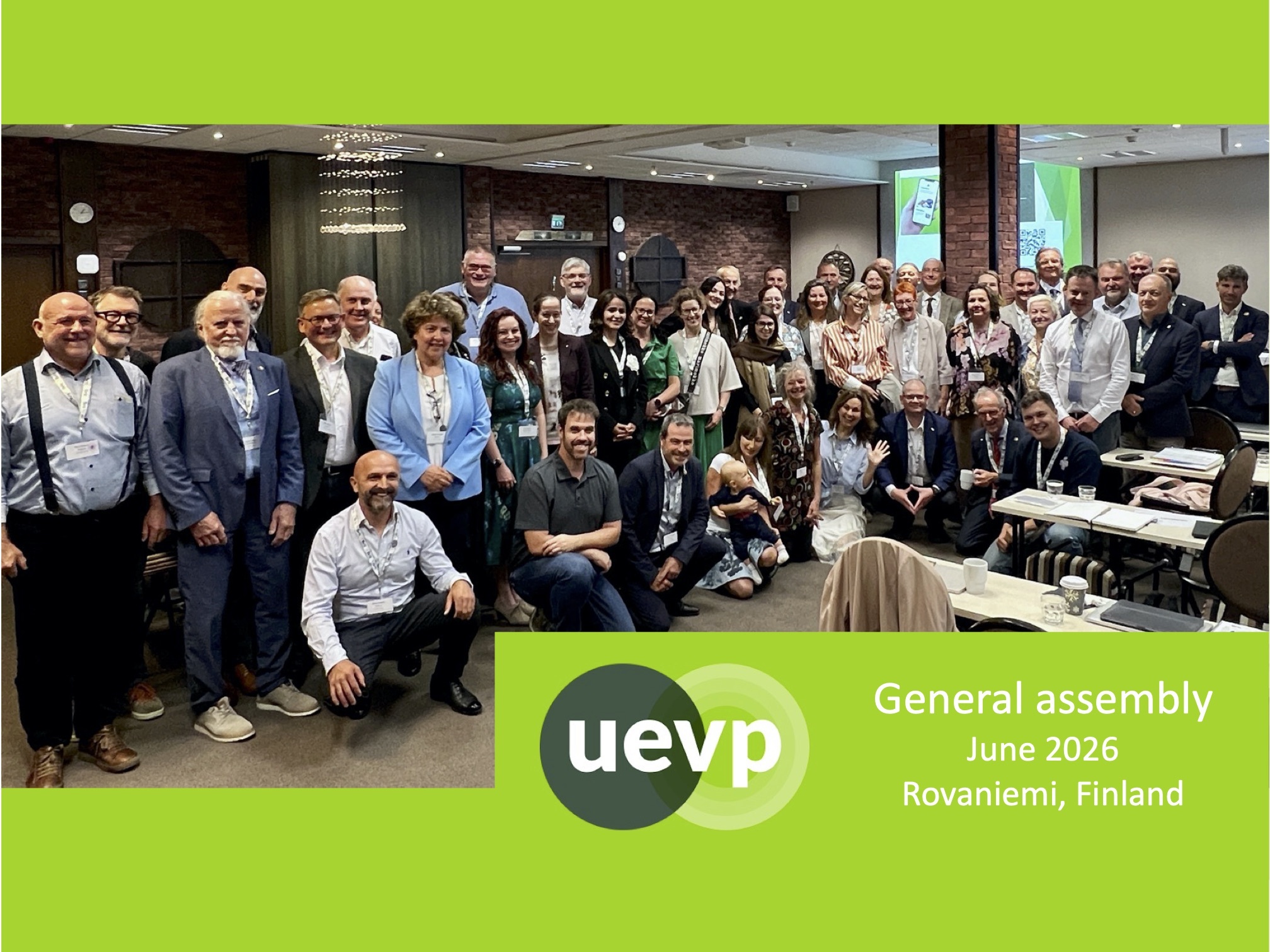
'Welcome to Rovaniemi, home to Santa Claus and the capital of Lapland,' said Volker Moser, President of the Union of European Veterinary Practitioners (UEVP) as he opened its General Assembly in Finland on 11 June, greeting 'all well-behaved children and adults.'
Veterinary ownership and professional independence
During his Presidential Report, Volker highlighted the European Commission’s referral of France to the Court of Justice of the European Union over veterinary ownership rules. He noted that UEVP is preparing a position paper on veterinary ownership and professional independence, as the outcome of the French case could have consequences well beyond France. The discussion, he stressed, is not about opposing investment in veterinary practices. However, “regarding ownership and governance, whatever the business model, veterinary decisions must remain veterinary decisions.” Vets fulfil essential public health and One Health responsibilities, he added, and should not be regarded as ordinary commercial service providers. Delegates from Austria, Hungary and Portugal pointed out that similar majority veterinary ownership requirements exist in their countries.
Digital transformation in practice
'Digital tools give us back time for what really matters: the patient,' observed Volker Moser. From AI-assisted diagnostics and telemedicine to wearable technologies, precision farming and emerging biosensing tools, digitalisation is becoming an integral part of veterinary practice. 'Technologies can and should be designed with us, not for us.' UEVP is therefore advocating for a joint FVE-EVERI working group dedicated to digitalisation and artificial intelligence.
UEVP Vice-President Julien Le Tual presented the digital community platform used by the French veterinary practitioners’ association SNVEL. 'It’s not one more tool, it is the place where everything comes together.' He described the platform as a personalised workspace offering direct access to committees, collaborative working areas and member resources. He suggested it could serve as a model for veterinary organisations across Europe.
Building professional networks: the UEVP app and summer school
As another example of digital success, UEVP board member Giovanbattista Guadagnini reported strong engagement with the UEVP app which has published more than 160 news items since the Leuven General Assembly. He encouraged member associations to promote the app and contribute content. UEVP has also expanded its communication efforts through LinkedIn.
He also reported that the first UEVP-supported Buiatrics Summer School in Italy had attracted 35 applicants from 13 countries, with 12 participants selected for the intensive programme in Brescia. 'This is more than just a training course,' he explained. 'It’s a chance to become part of a European network, get to know like-minded colleagues across Europe, and gain practical skills in dairy practice.'
Dog breeding and animal welfare in Finland
Guest speaker Tiina Pullola outlined Finland’s new Animal Welfare Act, which came into force in 2024. The legislation aims to ensure that dog breeding produces healthy, functional animals and addresses public concerns about extreme breeding practices. Upcoming provisions will furthermore require vets to notify the official dog register when diagnosing specified hereditary defects or conditions requiring corrective surgery. The information will be publicly accessible and apply to all dogs, pedigree and otherwise. The new decree also requires mandatory examination of extremely brachycephalic dogs, bans dogs from breeding if they are too fearful of aggressive or if they have had two or more caesarean sections. Similar provisions were in the pipeline for cats, she added.
Emergency killing: supporting difficult decisions
During her presentation on emergency killing in pigs, guest speaker Dorien Eppink (Netherlands) discussed the practical and ethical challenges faced by farmers and veterinarians. She defined emergency killing as ‘ending the life of an animal experiencing severe pain or irreversible suffering without realistic prospects of recovery.’ A decision tool, available in several languages, had been developed for livestock farmers helping them decide when to humanely kill piglets. Research showed that veterinarians are viewed as the primary advisers on these decisions. Discussions highlighted the importance of teaching decision-making and humane killing as core veterinary competencies during undergraduate education.
Transboundary diseases remain a major threat
Athina Trachili (UEVP board member, Greece) reviewed the growing impact of transboundary — and no longer “exotic” — diseases such as peste des petits ruminants, lumpy skin disease, African swine fever, bluetongue and others. Climate change, wildlife movements, illegal animal transport, high livestock densities and veterinary workforce shortages all contribute to the challenge, she said. She reiterated the profession’s position that if effective DIVA vaccines are available, large-scale culling should not be the default response, echoing the FVE position paper on vaccination.
Updates from UEVP member organisations
Representing FECAVA, Ann Criel raised concerns about medicated companion animal feed following the launch of a cat food containing benazepril. She highlighted potential welfare, safety and environmental issues of medicated feed, including accidental consumption by other pets or children and the presence of residues in waste.
On behalf of the Federation of European Equine Veterinarian Associations (FEEVA), Joe Collins presented new position papers on routine cervical radiography and oral examinations during pre-purchase examinations. He also reported progress on a review of assisted reproductive technologies across Europe.
Representing the European Association of Zoo and Wildlife Veterinarians (EAZWV), Sanne Hellström announced ongoing work on HPAI vaccination in zoo birds, a forthcoming position statement on animal transport and new travel grants for colleagues from lower-income countries.
Honouring service to the profession
Other presentations included guest speaker Pirkko Pirinen, on Finland’s model for veterinary preparedness and International Veterinary Students’ Association (IVSA) representative Eirini Polygerou giving an update of her association’s activities.
Former UEVP President Zsolt Pinter was awarded honorary membership in recognition of his 'exceptional commitment and tireless dedication to the welfare of the UEVP and the European veterinary profession.'
The next UEVP General Assembly will take place in Brussels on 12 November 2026.
(photo ©Karin de Lange)