
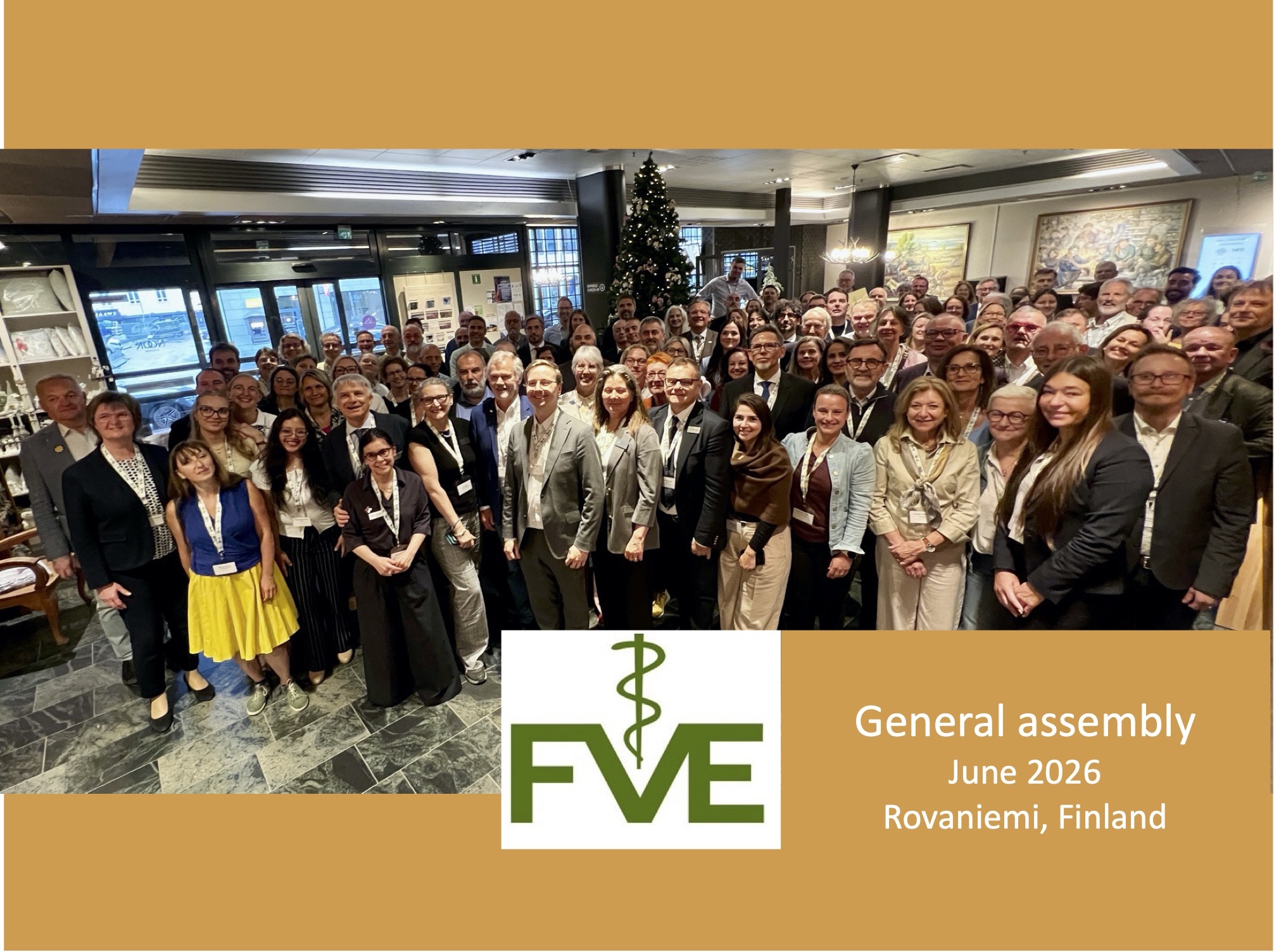
'Welcome to Rovaniemi, capital of Lapland and venue of the northernmost FVE General Assembly ever,' said Mikko Turku, President of the Finnish Veterinary Association, host of the meeting. Against the unique backdrop of Finland’s far north – where reindeer remain an integral part of daily life rather than a seasonal symbol – delegates gathered to discuss the challenges currently facing the veterinary profession.
Progress on prescription flexibility and medicines availability
One of the profession’s most prominent recent achievements, according to FVE President Siegfried Moder, was the European Commission’s clarification of Article 106 of the Veterinary Medicines Regulation. Until now, veterinarians are caught between strict compliance with the manufacturer’s product information (SPC) and their professional responsibilities towards animal welfare and public health. Following sustained advocacy by FVE and its member associations, the European Commission confirmed that the "cascade" can be applied if a different dose or dosage duration is required, providing greater flexibility in prescribing. FVE will revise its cascade leaflet accordingly, he added, with antimicrobial provisions to be discussed later. FVE also continues to address medicines shortages through the VetMed+ coalition, focusing on species with limited treatment options, such as small ruminants, waterfowl and bees. The renewed joint FVE/UEVP Medicines Working Group, chaired by Jean-Pierre Orand (France), will continue this work.
Biosecurity and animal welfare in focus
Biosecurity was another major topic in Rovaniemi. Delegates unanimously adopted the FVE Biosecurity position paper describing Animal Health Law visits as a key mechanism for delivering biosecurity advice on farms. The position complements the recent FVE position paper on vaccination under the banner “Prevention is better than culling” and coincides with the creation of a joint FVE/UEVP Animal Health Working Group dedicated to prevention, preparedness and evidence-based animal health governance.
Animal welfare also featured prominently in discussions. According to FVE Vice-President Mette Uldahl, the adoption of the upcoming EU Regulation on the welfare and traceability of dogs and cats represents 'one of the most significant developments of recent years.' The FVE/UEVP Animal Welfare Working Group, which has recently been renewed, has prepared supporting materials highlighting the regulation’s key provisions, alongside broader recommendations aimed at aligning future legislation with scientific evidence.
Understanding veterinary career choices
Career choices and the uneven distribution of veterinarians across sectors and regions was the theme of a panel session held during the GA. A joint survey – soon to be released – conducted by FVE and the International Veterinary Students’ Association (IVSA) found that most students aspire to clinical careers, particularly in companion animal practice. However, exposure to alternative career paths such as research, industry and public health remains limited. 'Lack of interest is often due to lack of knowledge,' noted IVSA President Tamy Negrón, highlighting the link between practical experience during studies and future career choices.
Petra Winter (EAEVE) stressed the importance of keeping an open mind, as 'there is no "biomarker" to select the right person as future vet.' She added that students and recent graduates are already part of accreditation visits and will be closer involved in EAEVE internal committees.
Practical solutions to help students in their orientation
Several initiatives showcased practical solutions. EVERI has launched industry internships in collaboration with pharmaceutical company CEVA; Austria reserves veterinary school places for public health and rural practice careers; Croatia has introduced scholarships linked to farm animal practice; and Italy’s Buiatrics Summer School is helping young vets build European networks in bovine medicine. Complementing these initiatives, the University of Bern has created an online self-assessment tool to help prospective students align expectations with the realities of veterinary studies and professional life. 'More of a reality check than an entry exam,' noted Roberto Mossi, President of the Swiss Veterinary Association.
Addressing rural veterinary shortages
Delegates also shared examples of efforts to attract and retain veterinarians in rural areas. France has developed data-driven mapping tools to identify current and future underserved regions, while the department of Yonne has established a municipally-funded veterinary clinic. Norway obtained government funding for mentoring schemes and practical assistance. Romania is addressing a significant outflow of veterinarians through financial incentives for large animal practices. Spain, meanwhile, is calling for greater investment in rural veterinary services rather than the creation of additional veterinary schools.
Wellbeing, burnout and changing practice models
Preliminary findings from the 4th VetSurvey, based on the input of over 11,000 respondents from 39 countries, revealed persistent wellbeing concerns, although stress levels are slightly down from three years ago, noted FVE Executive Director Nancy De Briyne. Across Europe, 22% of veterinarians reported taking at least a two-week break due to burnout during the previous three years, with substantially higher figures in some countries. For the first time, VetSurvey included questions on harassment, revealing that abusive behaviour remains a common experience within the profession. Younger veterinarians were particularly affected, with almost half of respondents under 35 reporting harassment from clients. The survey also highlighted the growing role of corporate veterinary practice. On average, 20% of veterinarians now work in corporate settings, with particularly high levels in the United Kingdom (45%), Sweden (31%), Norway and Portugal (29%). In a shift from the previous VetSurvey (2023), however, private vets are now doing better financially and had higher job satisfaction than those working in corporate practice. This edition is the first to gather input from veterinary nurses and to address the use of artificial intelligence. The final VetSurvey report is due in September.
Professional independence under scrutiny
Corporates were also discussed in the context of the European Commission’s referral of France to the Court of Justice of the European Union over veterinary ownership rules. Dietmar Gerstner (Austria), Chair of the Statutory Bodies Working Group, noted that similar ownership provisions – veterinary practices requiring a majority veterinary ownership – exist in several Member States, including Romania, Austria and Portugal, and that the outcome of the French case could have implications far beyond national borders. UEVP is currently preparing a position paper on veterinary ownership and professional independence, underlining that veterinary services fulfil an essential public health and One Health function and should not be viewed as ordinary commercial services. The French delegation welcomes input and experiences from other countries in preparation of the court case.
From reindeer health to biological threats
The programme also explored uniquely northern challenges. Hanna Nurmi described reindeer as “the livestock of the sun,” highlighting their cultural, economic and environmental importance to Arctic communities. Climate change and increasing land use pressures are creating significant challenges for reindeer husbandry, while the animals themselves are highly susceptible to heat and handling stress, making treatment challenging.
A presentation by Olli Jokinen of the Finnish Defence Forces examined biological threats and preparedness. While bioweapons remain a concern, he emphasised that damage to water, sanitation and healthcare infrastructure during conflicts is often more likely to trigger disease outbreaks than deliberate biological attacks.
Sections meetings
EASVO – The State Officers’ section launched the new EASVO Early Career Network (formerly the Young EASVO Network) and invited nominations from non-EASVO and the wider FVE membership. During a joint session with UEVH, members explored opportunities for closer cooperation between the two sections.
EVERI – The section of vets working in education, research and industry discussed developments in artificial intelligence and announced a new one-week internship programme at CEVA, offering veterinary students first-hand exposure to the pharmaceutical industry and careers beyond clinical practice.
UEVH – The veterinary hygienists’ section adopted position papers on fertilisers in sustainable agrifood systems, lab-grown meat and aflatoxins in milk. It also discussed the future role of veterinarians in meat inspection and agreed to develop a joint position paper on the topic with EASVO.
UEVP – Discussions focused on a forthcoming position paper on veterinary practice ownership and professional independence in the context of the ongoing French court case. Members also proposed establishing a joint task force with EVERI on digital transformation and artificial intelligence in veterinary practice. For more details see the UEVP GA report.
Looking ahead
The next FVE General Assembly will take place in Brussels on 13 November, preceded by section meetings on 12 November. A dedicated workshop on antimicrobial resistance, organised within the EU-JAMRAI2 framework, will follow on 14 November. The spring 2027 GA will be held in Garmisch-Partenkirchen (Germany) on 18-19 June.
(Photo ©Karin de Lange)