
Foot-and-mouth disease and medicines high on the agenda
‘We’ve been busy,’ reported Volker Moser, UEVP president, during his address to the general assembly, held on 26 June in Leuven, Belgium. Since the last GA in November, UEVP board members had attended numerous European meetings on a range of topics, he said, including antimicrobial resistance, veterinary education, pet welfare and identification. They had also met with national and regional associations to discuss medicines availability (Spain), foot-and-mouth disease (Visegrad) and the administrative burden of vets (Switzerland). Many of these topics were also discussed in Leuven.
Dispensing ban in Spain and lack of medicines in Czechia
‘New legislation in Spain has completely banned the dispensing of medicines by vets, even for in-clinic cases, and has escalated our administrative burden, with hefty penalties in case of transgression,’ reported Xavier Cornet Illa, veterinary practitioner representing the Spanish Veterinary Council. ‘Even compared to the European law (2019/6), the new Spanish law is much stricter.’ Spanish vets had held nation-wide strikes to help raise awareness, which had gained political momentum. ‘All we ask for is a fair Regulation.’
‘In the Czech Republic, only half of all EU-authorised antimicrobials are available to vets,’ regretted guest speaker Lucie Pokludová, Czech representative of the European Medicines Agency, describing the problems of veterinary medicines availability in her country, considered a ‘minor market’. ‘For example, there is no category D (AMEG) antibiotic available, such as amoxicillin or penicillin, meaning that vets are obliged to use category C antimicrobials, such as amoxiclav. This is hardly ideal in view of the fight against antimicrobial resistance.’
FMD lessons learnt: ‘more manpower’ and ‘more awareness’ required
With barely three months since the last European outbreak of foot-and-mouth disease, colleagues from the various countries involved shared their experience. ‘One of the lessons we learned from the outbreaks: calculate twice the amount manpower you think you need,’ said Roman Matejčík (State Veterinary Services, Slovakia). ‘Altogether – including firefighters, police, customs officers and the army – we needed 30,000 man-days, of which 7,000 man-days of veterinary professionals to control the outbreaks.’
‘Our previous FMD outbreak was 50 years ago, and the awareness of the disease among vets and farmers was perhaps not as high as it should be,’ admitted Borbála Bende, veterinary and food safety attaché of Hungary to the EU. She saw an important role for practitioners during outbreaks, such as control (early detection and surveillance), prevention (advice on biosecurity) and to be kept in the loop regarding decisions and consequences.
FMD lessons learnt: calls for simulation exercises and resilience training
‘We should be better prepared, especially as young farmers and vets have never seen the disease,’ agreed Iris Fuchs, state veterinary officer and president of the Bavarian veterinary chamber (Germany). ‘We should do yearly simulation exercises, but we simply don’t have enough workforce.’ She welcomed a recent decision requiring mandatory laboratory investigation of any vesicular disease in cloven-hoofed animals. She also praised the reactivity of key decision makers who communicated via a WhatsApp group.
‘We faced veterinary recruitment challenges,’ reported Zoran Nikolic, of the Berlin veterinary services, recounting the January outbreak in Brandenburg (Germany). ‘There is a clear lack of training, much bureaucracy and also psychological strain, because who wants to kill animals?’ While he praised the transnational collaboration and was proud the FMD-free status had been restored within three months, ‘it would have been nice to have an emergency veterinary pool and benefit from resilience training.’
FMD preparedness in the rest of Europe
Although Austria did not suffer outbreaks, it was included in the surveillance zone, ‘which had a huge economic impact,’ observed Andrea Leutgöb-Ozlberger, state veterinary officer. Border crossings with Hungary and Slovakia had remained closed for six weeks. Barriers and disinfection mats had been put in place, while ground water and wells were investigated for traces of the virus, as burial sites were located near the border. ‘Veterinary authorities mainly called upon companion animal and equine vets, as they would suffer less consequences for their practice in case of infection,’ explained Dietmar Gerstner, large animal practitioner form Austria, adding that veterinary volunteers were paid 140€ per hour plus travel compensation of 0,50€/km.
‘Animal health visits, mandatory according to the EU animal health law which came into force in 2021, could certainly avert outbreaks of infectious diseases and ensure faster reporting, reducing their spread,’ regretted Nancy De Briyne, FVE executive officer. ‘During these animal health visits, the focus is on biosecurity and early detection of emerging diseases, so of great importance.’ However, ‘more clarity is needed on the scope and frequency of these visits’. When implemented properly, ‘it’s a win-win-win situation for farmers, society and the agrifood sector,’ she stressed.
Of ethics and Internships
‘Vets are confronted with ethical issues on a daily basis – whether animal abuse, lack of welfare during transport or euthanasia of healthy kittens,’ noted guest speaker Tanja Wagner, veterinarian and journalist in ethics, speaking on the topic of veterinary ethics in a joint session with the other sections (EASVO, EVERI and UEVH). The word ‘euthanasia’ was clearly one of the key words when the assembly was asked – via an electronic survey – to provide examples of real-life ethical dilemmas for vets.
Results of a survey among 111 veterinary interns (760 internships) were presented by Julie Rosser, chief executive officer of the European Board for Veterinary Specialisation. She provided data such as employment status, number of hours worked, support and subsequent jobs and salaries. ‘Interestingly, with the exception of Belgium, former interns did not gain higher salaries than new graduates.’ She concluded there were great differences between types of internships and countries, and called for common standards ‘to promote transparency and fairness.’
UEVP app & board elections
‘If you have a matter to report on, please send us some short news from your country, and we can help disseminate it thanks to the UEVP app,’ said Giovanni Guadagnini (UEVP vice president), presenting the app, now up and running, together with Ann Criel (UEVP vice president). Ann urged colleagues to download the app, now available for both iOS and android devices, and share it with colleagues. ‘We will soon have a share button,’ she promised. President Volker Moser added that the contract with Euralia had not been renewed.
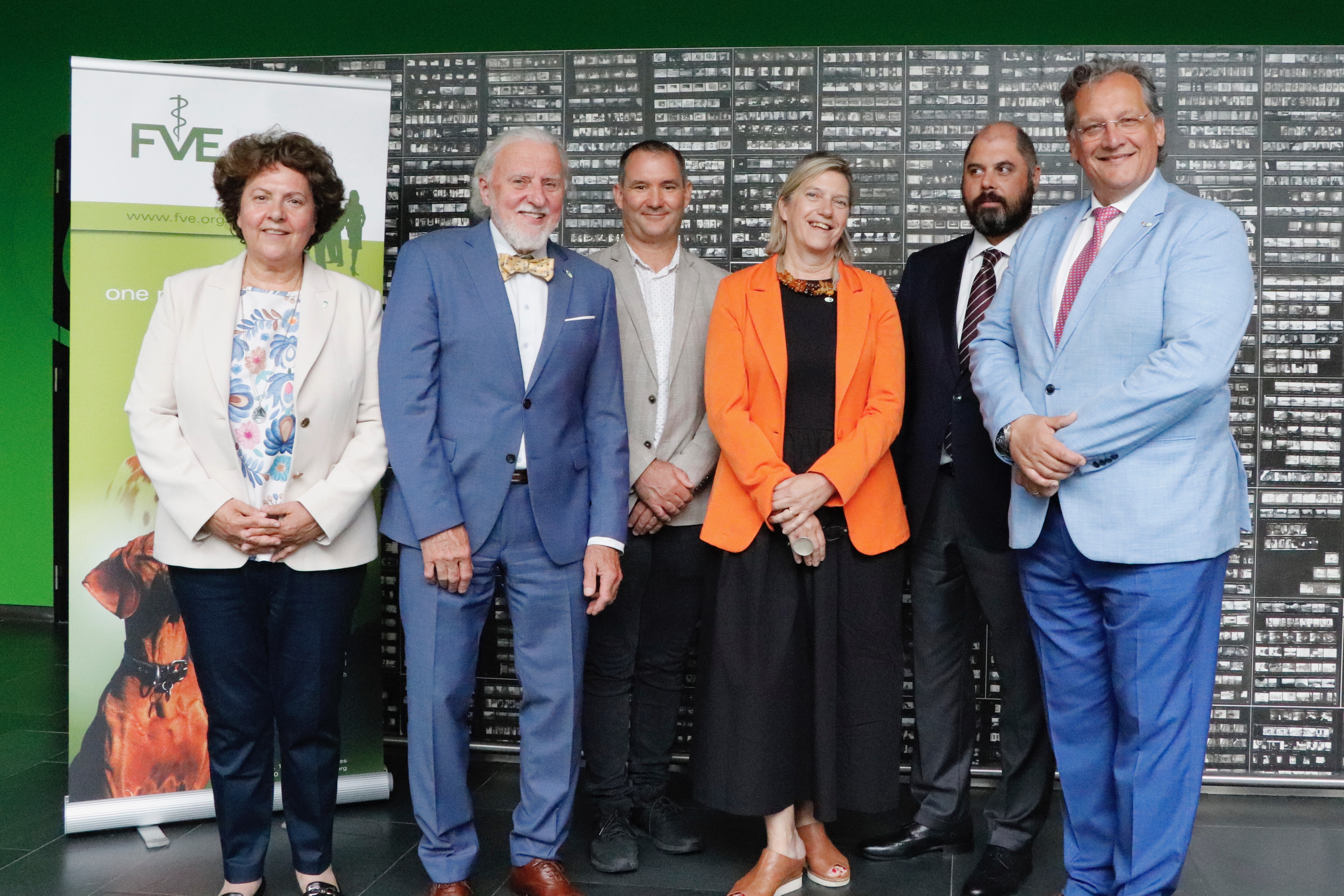
The UEVP board was re-elected for a second mandate (2025-2027). Outgoing board member Kenelm Lewis (UK) was replaced by Julien Le Tual, large animal practitioner form France. A reshuffle of the board now has Volker Moser (Austria) as president, Athina Trachili (Greece) as general secretary, Giovanni Guadagnini (Italy) as treasurer and Ann Criel (Belgium), Jan Bernardy (Czech Republic) and Juan Le Tual as vice presidents. The next UEVP general assembly will be held in Limassol, Cyprus, on 13 November, where the UEVP will be celebrating its 55th anniversary.