
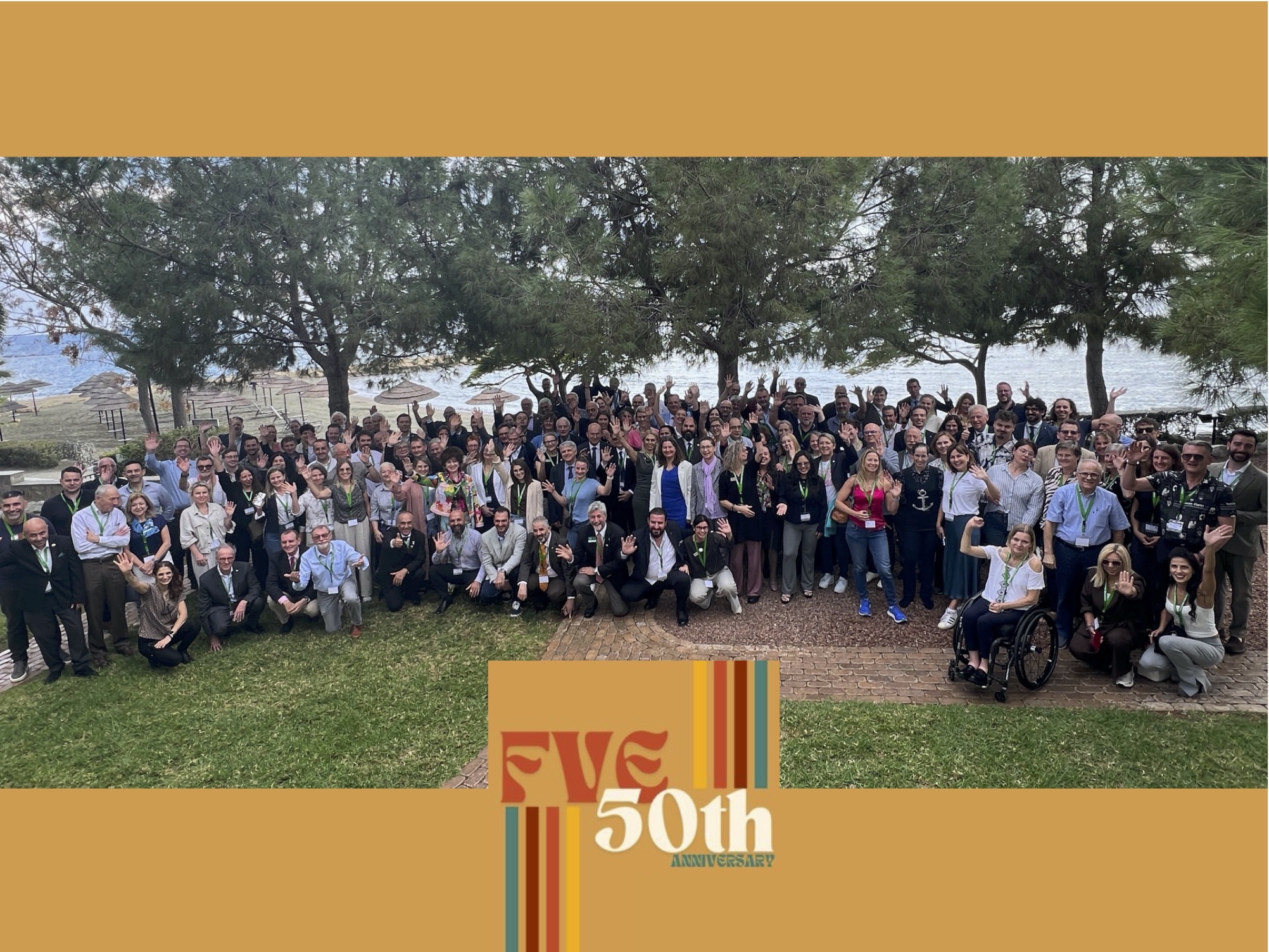
‘We warmly congratulate the FVE for its 50 years of dedication promoting animal health, animal welfare, public health and food safety,’ saluted Demitris Epamonidas, president of the Pancyprian Veterinary Association, host of the November FVE general assembly in Limassol, Cyprus. The 50th anniversary was celebrated in style (dress code: the 1970s) but with many timely topics on the agenda.
Adopted: position paper on animal vaccination
“Vaccination is better than culling – we should not accept senseless culling, of tens of thousands of animals during recent disease outbreaks of foot-and-mouth disease and avian influenza – we need a different strategy,” stressed Siegfried Moder, FVE president of during his opening address of the FVE general assembly ‘In Europe, there have been over 26,000 disease outbreaks in the first six months of 2025 alone, of which 330 first occurrences in a country.’ After presentations on animal health outbreak control by delegates from Cyprus, France, Italy and Ireland, the general assembly unanimously adopted the FVE position paper on Animal Vaccination. The paper recalls that ‘animal vaccination is a vital cornerstone of Europe's health, economy and sustainability and is an essential part of the veterinary toolbox.’
Biocheck, the free biosecurity scoring system
‘In the EU Animal Health Law, the word ‘veterinarian’ is mentioned 49 times – but ‘biosecurity’ 70 times,’ observed guest speaker professor Jeroen Dewulf (UGent). ‘While biosecurity is not the silver bullet that solves everything, working on biosecurity can help address many challenges, including sustainability, control of epidemics, endemic and zoonotic disease, and a reduction of antimicrobial use,’ he added. To help quantify and improve on-farm biosecurity he described Biocheck, developed by the University of Ghent. ‘Biocheck, a freely available tool in many languages, is a risk-based scoring system and a decision support system. Questions such as ‘Are there wild boars in the area?’ ‘Is the farm fenced?’ ‘Do you wash your hands between units?’ can be used to identify strong and weak points.’ Volker Moser, UEVP president, added: ‘Biosecurity matters – which is why the UEVP recommends the creation of an Animal Health working group to help vets be the recognised guardians of biosecurity.’
Adopted: Strategy 2026-2030 and Fur farming position paper
The FVE strategy 2026-2030 was unanimously adopted in Limassol. Its new vision states that ‘FVE will ensure that our profession is trusted to safeguard the health and welfare of animals, people, and the planet.’ FVE Executive director Nancy De Briyne furthermore announced that a fourth professional survey would be held in 2026, which would be extended to the veterinary nursing profession. Also adopted was the FVE/FECAVA/WSAVA position paper on the phasing out of fur farming. ‘Animals bred for fur are wild or semi-wild species whose complex needs cannot be met satisfactorily within the confines of conventional fur farms,’ recalled Mette Uldahl, FVE Vice President. Furthermore, ‘it’s a luxury product, not a production system needed to feed the world.’
Feline infectious peritonitis: the Cypriot outbreak and access to treatment
Cyprus was also the fitting setting to discuss the treatment of feline infectious peritonitis (FIP), said Demetris Epaminondas, co-author of the paper describing the FIP outbreak on Cyprus in 2023. FCoV-23, a viral strain described for the first time, caused a different kind of FIP, ‘highly suggestive of direct transmission’, affecting cats of all ages, with a large percentage of cats showing neurological signs. The outbreak also highlighted the urgent need of a legally available treatment for FIP. In Cyprus, a temporary special permit was granted for oral molnupiravir. ‘The FVE is actively lobbying for the availability of safe and efficient legal FIP treatment options in every European country,’ reassured Wiebke Jansen, adding that the FVE regularly updates its leaflet on FIP treatment in Europe. Furthermore, in answer to a written question from members of the European Parliament, the Commission confirmed that GS-441524 is authorised for use by vets throughout the EU (provided that conditions of Article 112 in EU Regulation 2019/6 are observed).
Corporates, veterinary fees and market investigations
The veterinary companion animal market is a complex and rapidly evolving, with an increasing role for corporates,’ observed Nancy De Briyne, citing a recent FVE publication. ‘In Germany, there are an estimated 500 practices out of a total of 10,000 that are part of a corporate, reported Heiko Färber, managing director of the German Association of Veterinary Practitioners (BPT). ‘In our country, we have legally binding pricing standards, with minimum and maximum costs for veterinary fees called GOT, most recently updated in 2022. This 100-page document is publicly available and also applies to corporate practices.’
‘In France, an estimated 23.5% of vets are currently working for a corporate,’ explained Jean-Pierre Orand (France), with 17.8% working for the ‘top five’ (Evidensia, MyVeto, Sevetys, Univet and Anucura). But while the number of corporates seems to be stabilising, ‘the average number of vets per corporate is on the increase.’ Since 2021, veterinary revenue in France has increased by 34%, while the overall activity only increased by 3%. This led to a market investigation by the French competition authority on veterinary pricing, Patrick Govart reported.
Call for improved transparency
In the Netherlands, retrospective research (2019-2024) showed that veterinary prices had risen at more than twice the level of inflation, noted Sophie Deleu, president of the Dutch veterinary association KNMvD, ‘in particular those of corporate practices and emergency care.’ This had led to market investigation and steps by the veterinary profession to improve price transparency, develop professional standards for emergency care and launch a new, unified professional organisation for veterinarians and affiliated professions such as paraveterinarians.
In the UK, the Competition and Market Authority had recently published its proposed remedies, reported Liz Mullineau (British Veterinary Association), including transparency on price lists and practice ownership, a veterinary price comparison website and making it easier to access cheaper medicines online. However, ‘online pharmacies are often in the hands of corporates, reminded Lizzie Locket (RCVS), and continuity of care and long-term client-veterinary relationships are key’.
Addressing workforce shortages
Mette Uldahl reported on Vet Joy initiatives, including outreach programmes at schools, workplace awards, team coaching vouchers and resources on how to become a vet. Gabriele Moog (BPT) described a new approach of addressing veterinary workforce shortages in Germany – aimed at the parents of future students. ‘Parents are the most important source of advice for young people choosing their profession’. Live online sessions had been set up where parents and potential students could interact with veterinary professionals in practice, to allow ‘future vet students get a more realistic, less romanticised view of the profession.’
A recent FVE survey had highlighted the important administrative burden of veterinary professionals – a notion echoed by Alain Schonbrodt (UPV). ‘It is the number one risk factor causing vets in southern Belgium to leave the profession,’ he said, citing the findings of Obsvet, an observatory of the veterinary profession. He also underlined the lack of practising veterinarians, in particular in the large animal and equine sectors.
Section reports
- EASVO: the section had celebrated its 45 years. A new board had been elected, with Mark McCarthy (Ireland) – president, Andrea Leutgöb-Ozlberger (Austria), Mikko Turku (Finland), Cornelia Rossi-Broy (Germany) and Jean-Pierre Orand (France). EASVO also invited FVE members to nominate state veterinary officers to join as observers to the young EASVO network for 2026.
- EVERI: the section was also celebrating its 50th anniversary, first starting out as FEVIR in 1975, with a rebirth as EVERI 20 years ago. The section, whose board was reelected, has close ties with the International Veterinary Students’ Association, and announced the creation of a working group on artificial intelligence.
- UEVH: The section had discussed a range of position papers, including one on laboratory-produced meat, raw meat pet food and the zoonotic risk and the role of vets in milk production.
- UEVP: Ukraine had become observer member. The Animal Health Visits under the new Animal Health Law had been discussed, and the UEVP recommends the creation of an Animal Health working group. Andrew Robinson, Piotr Kwiecinski, Thierry Chambon, Rens van Dobbenburgh, Kenelm Lewis and Nancy De Briyne had become UEVP honorary members.
The next spring general assembly will be held in Rovaniemi, Finland from 11-13 June, with the autumn GA in Brussels, on 12-13 November.
(Photo ©Karin de Lange)