
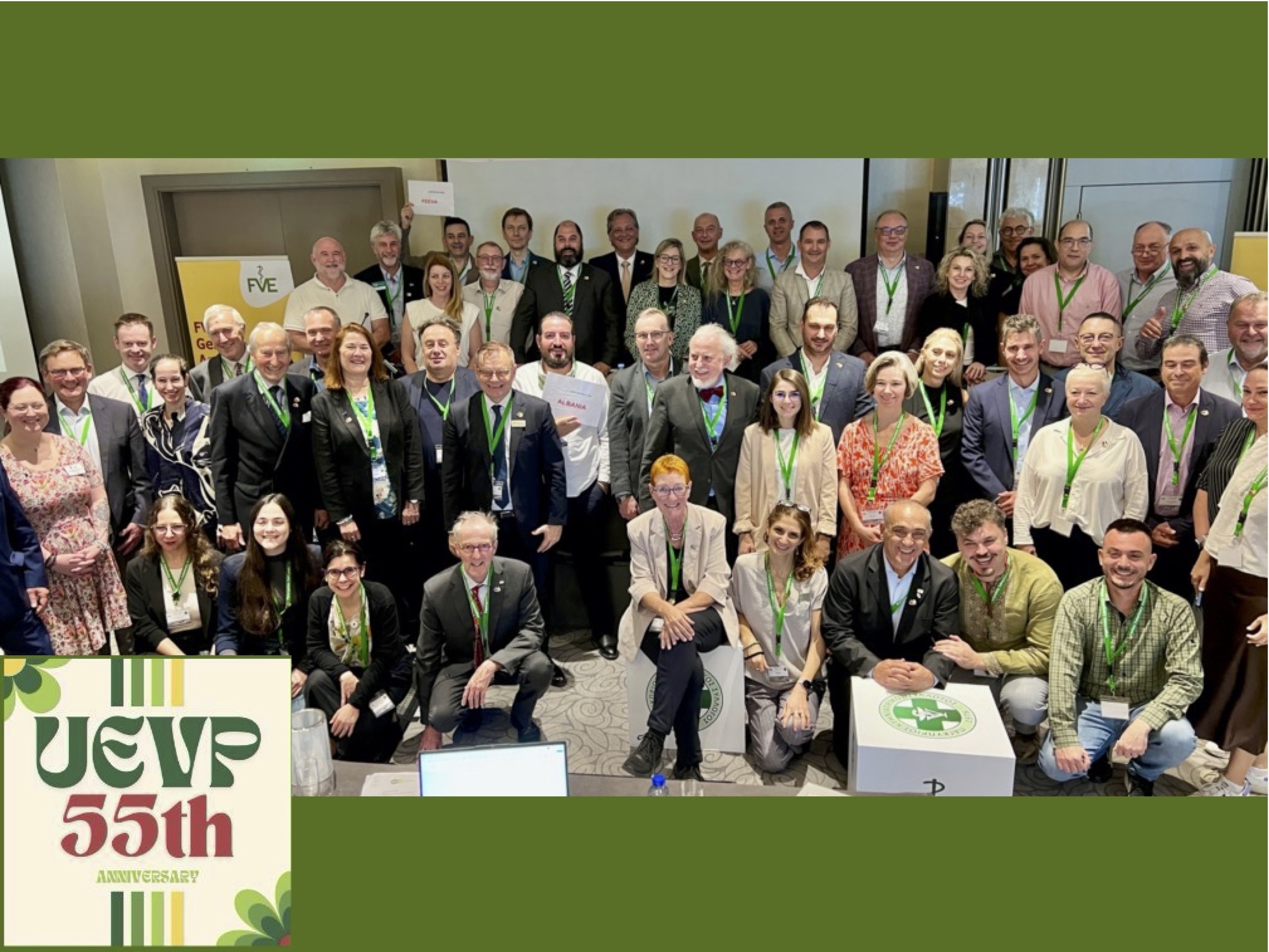
‘We are a small but united profession, and we can only achieve success through alliances,’ observed Rens van Dobbenburgh, former UEVP board member and FVE past-president, speaking at the Union’s 55th anniversary during last month’s general assembly in Limassol, Cyprus. In the early years, the UEVP focused on certification, medicines and the visitation of veterinary schools. More recently, workforce shortage, corporatisation, DEI and the responsible use of antimicrobials have joined the agenda – challenges that remain highly relevant today.
Animal health visits – ‘a great tool given to vets’
Animal Health Visits (AHVs), as defined by article 25 of the EU Animal Health Law, represent ‘a great tool given to the veterinary profession by the EU – but we need to use them properly,’ stressed Piotr Kwiecinski, former UEVP president and current FVE board member, during a dedicated session on AHVs. Despite being a legal requirement, these visits are still not fully implemented in all Member States, and none have done so for 100%, he noted, citing an FVE survey. Three delegates then shared experiences on how AHVs are carried out in their respective countries.
AHVs form the ‘backbone of disease prevention,’ underlined Siegfried Moser, cattle practitioner from Germany and FVE president. ‘Prevention is better and safer than cure, and is better than culling!’ AHVs should deliver practical advice on disease prevention and ultimately lead to stronger biosecurity, improved animal health and welfare, earlier disease detection, reduced antimicrobial use and better productivity. Together with state veterinary officer Iris Fuchs, he also highlighted the importance of close collaboration between practitioners and official veterinarians. For the FVE, he identified the need for ‘defining minimum inspection criteria, risk management tools for visit frequency and clear guidelines.’
Animal health visits in Germany, Italy and France
‘During animal health visits in Italy, we collect a range of data on welfare and biosecurity, samples for pathogen analysis and sensitivity testing, take photos of lesions, necropsy results and reports on slaughterhouse findings,’ explained Giovanbattista Guadagnini, UEVP board member and pig practitioner from Italy. ‘All data are entered into a central database (Classyfarm), allowing benchmarking and feedback reports to discuss with the farmer.’ Vets are at the heart of this system, he said, while emphasising that ‘farmers and official veterinarians are also part of the equation – we all need to work together.’
Julien Le Tual, UEVP board member and cattle practitioner from France, presented the French approach. ‘We use a comprehensive health barometer based on digital tools like CalypsoVet, our national health database, and VetAppli, a decision-support tool for monitoring key indicators. We’ve also developed a standardised questionnaire allowing a methodical approach, giving practitioners objective indicators.’ Outcomes are rated as ‘under control’, ‘in progress’, ‘to be improved’ or ‘at risk’. Visits typically take about one hour, he added, with vets receiving 184€ per visit.
Working group on Animal Health to be set up
During the discussion, delegates stressed the value of sharing information on existing systems and checklists across Member States, as well as promoting data-sharing among farmers and official veterinarians. ‘We should have harmonised checklists and advocate for the training of practitioners,’ suggested Piotr Kwieciński. UEVP president Volker Moser further proposed that European practitioners should create a task force on Animal Health Visits, including for the equine and companion animal health sector, to gather information on existing systems.
A joint session on biosecurity followed with other FVE sections: hygienists (UEVH), state veterinary officers (EASVO) and vets in education, research and industry (EVERI). Much of the debate centred on the role and responsibilities of veterinary practitioners. ‘Vets are in charge of providing advice on biosecurity and for monitoring it – but we’re not legally responsible for the follow-up of our advice,’ recalled Milorad Radakovic (UK), lecturer in public health at Cambridge veterinary school. The assembly proposed establishing a joint working group on animal health – to include animal health visits.
Feeva: issues with ID & registration of horses
‘In Ireland, we have a major problem with the identification and traceability of horses,’ reported Joe Collins, of the Federation of European Equine Veterinary Associations (Feeva) during the ‘elevator pitch’ sessions of UEVP member organisations. ‘Four key issues have been identified by veterinary practitioners: late and non-registration of the horse; phenylbutazone and the food chain; owner awareness of the criteria for “signing out” horses from the food chain; and end of life of horses destined for the food chain.’ He warned that, with no horse slaughterhouses in Ireland, exportation ‘compromises welfare and increases the risk of fraud.’
Fecava: menopause hub
‘The Federation of European Companion Animal Veterinary Associations has a new board,’ announced the newly elected Fecava president Ann Criel (Belgium). She presented the new Fecava logo and shared news of a dedicated menopause hub with resources. ‘Our profession is increasingly female, with a growing number of females over forty,’ she explained. Other priorities include mid-tier certification for practitioners and support for the veterinary nursing profession.
And also…
- On the occasion of the UEVP’s 55th anniversary, Andrew Robinson, Piotr Kwiecinski, Thierry Chambon, Rens van Dobbenburgh, Kenelm Lewis and Nancy De Briyne became UEVP honorary members.
- The Ukrainian society of veterinary business owners became a UEVP observer member during the general assembly.
- The next GA of the UEVP will take place in Rovaniemi, Finland, on 11 June 2026.
- Presentations are available (for UEVP members) here.
(Photo ©Karin de Lange)